

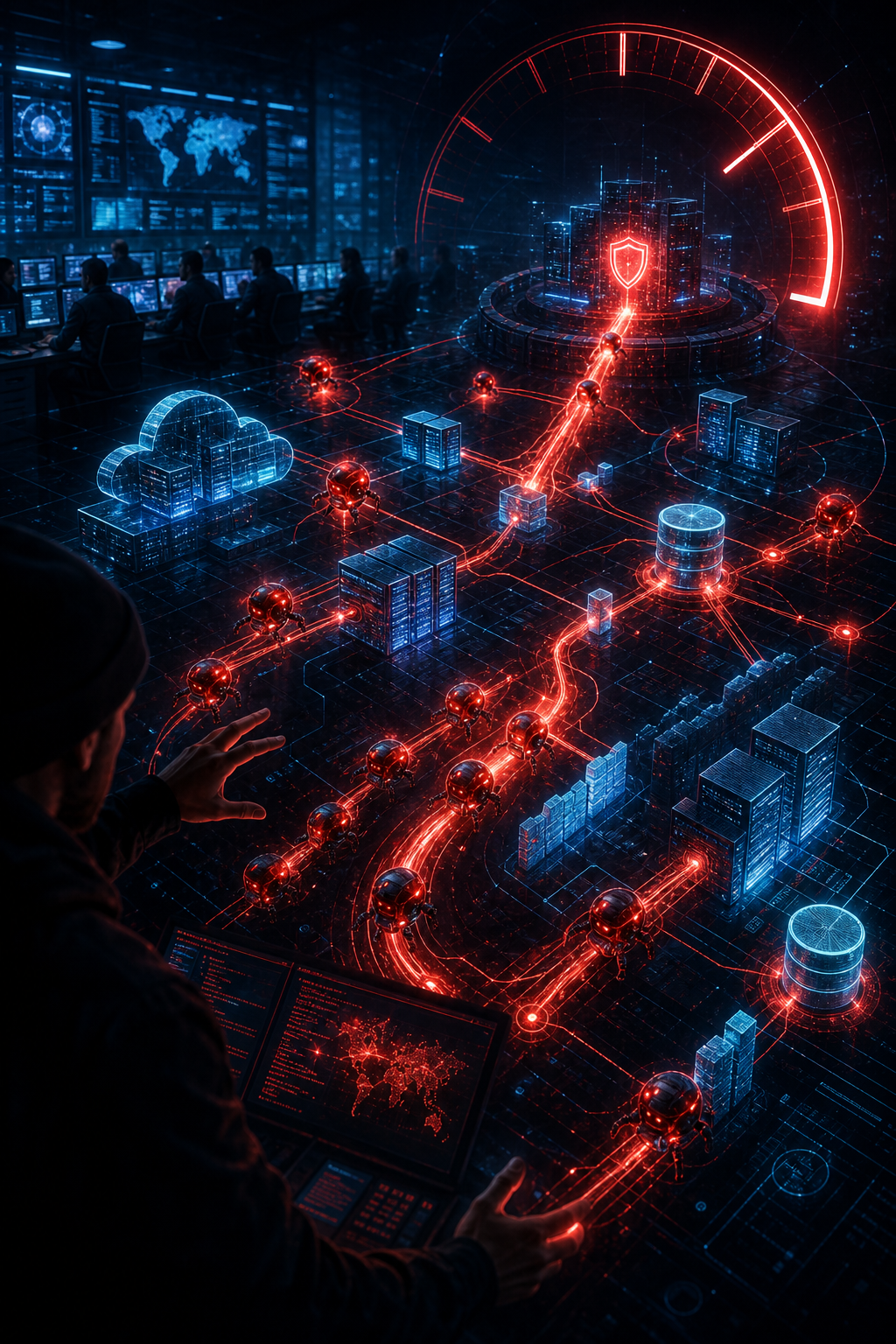
AI Agents Help Hackers Breach Enterprise Network in Under 10 Hours
Palo Alto Networks’ Unit 42 documented an enterprise intrusion in which a human attacker used AI agents to automate reconnaissance, exploit weaknesses, move through the network and obtain privileged credentials. The operation took less than 10 hours, compared with nearly two weeks for a conventional human-led attack.
The incident shows how AI can increase the speed and scale of cyberattacks, challenging defenses designed for slower intrusions. Researchers recommend faster monitoring, stronger privileged-access controls and improved visibility into automated activity, while organizations also secure the AI systems they deploy.
A cyberattack that once could have taken human hackers nearly two weeks was compressed into less than 10 hours with the help of advanced artificial intelligence agents, highlighting how rapidly AI is changing the cybersecurity threat landscape.
Researchers at Palo Alto Networks’ Unit 42 documented an attack in which a human threat actor used AI agents to automate and accelerate multiple stages of an intrusion against an enterprise network. The investigation shows that AI is no longer simply assisting attackers with individual tasks but can help coordinate complex operations at unprecedented speed.

According to the researchers, the attacker used frontier AI models and agentic tools to conduct reconnaissance, identify weaknesses, move through the targeted environment and obtain high-level credentials. The speed of these actions allowed the intrusion to progress far faster than a conventional human-led operation.
The incident is significant because AI agents can work continuously and perform multiple related tasks without requiring a human to manually direct every step. This gives attackers the ability to scale activities that previously required teams of skilled operators and large amounts of time.

Cybersecurity experts warn that this shift could create a new challenge for organizations. Security systems designed around slower attacks may struggle when reconnaissance, credential theft and movement through a network happen within hours rather than days.
The development also demonstrates why companies are increasingly focusing on securing AI systems themselves. As organizations give AI agents access to business applications, databases and other tools, those same capabilities could become potential targets for attackers or be misused during an intrusion.

The researchers say the incident should serve as a warning for security teams to rethink how they detect and respond to attacks. Organizations may need faster monitoring, stronger controls around privileged access and better visibility into automated activity as AI-powered attacks become more capable.
The emergence of AI-assisted cyberattacks does not mean that human hackers are becoming unnecessary. Instead, it shows that AI can dramatically increase what a single attacker can accomplish in a short period. As these systems continue to improve, the race between AI-powered attacks and AI-powered cyber defense is likely to become one of the defining security challenges of the coming years.