

A New Era of Discovery: Unprecedented Milestones in Space Exploration and Astronomy
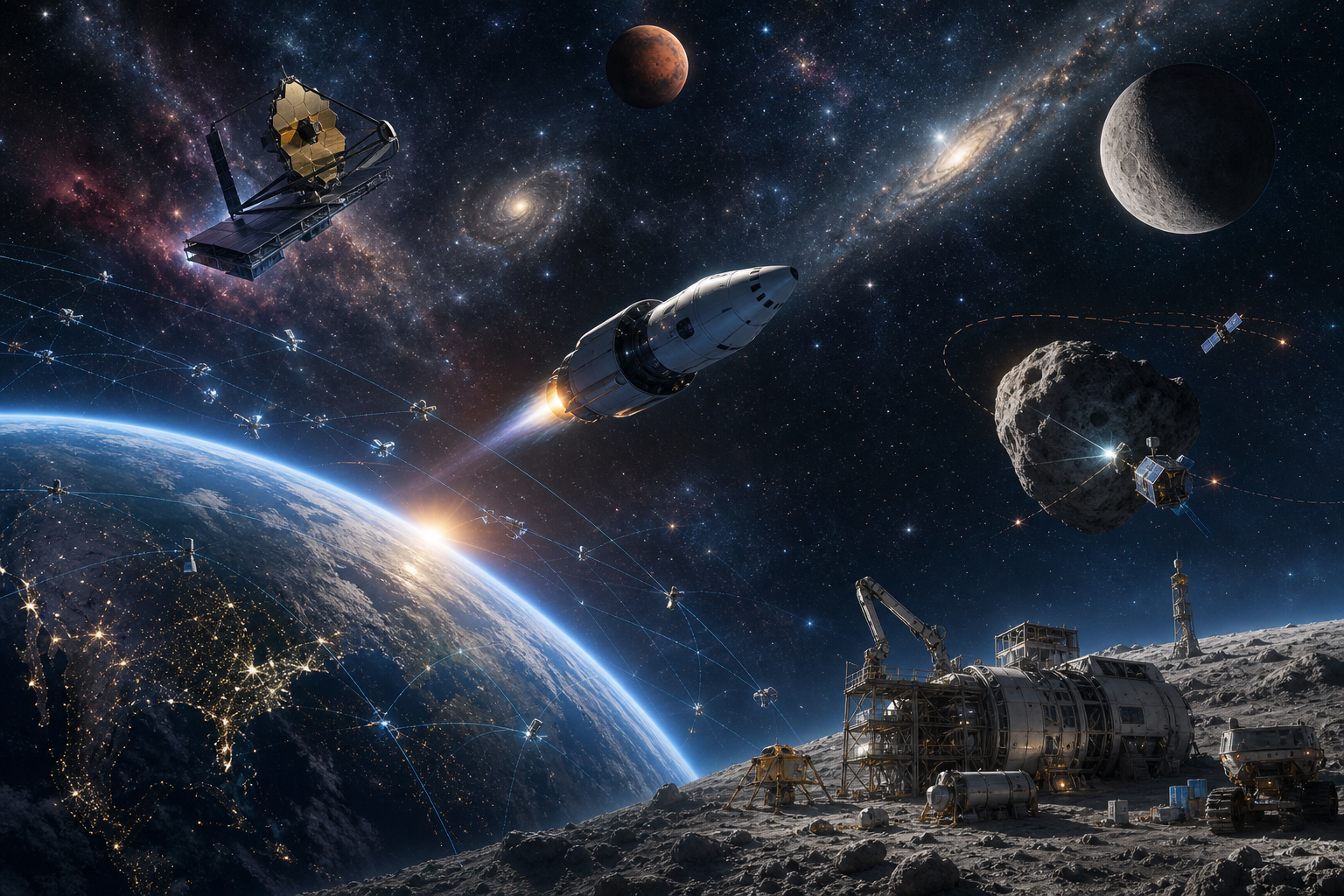
Space exploration and astronomy are entering a period of rapid development, driven by record launch activity, commercial investment, government programs, and international collaboration. Crewed missions are testing technologies for sustained lunar exploration and future Mars missions, while robotic probes investigate asteroids, planetary moons, and Mercury.
Next-generation infrared telescopes are studying cosmic expansion, dark energy, and exoplanet atmospheres. At the same time, planetary defense missions are improving asteroid detection and deflection capabilities, linking scientific exploration with efforts to protect Earth.
Space exploration and astronomy are experiencing a golden era, defined by remarkable technological leaps, deep-space missions, and a surge in international collaboration. Over the past year, the global space sector has shattered previous launch frequency records, driven by a combination of ambitious government programs and a rapidly expanding commercial space industry. These developments are not only expanding humanity’s physical presence beyond Earth but are also revolutionizing our understanding of the cosmos.
A primary driver of this renewed momentum is human spaceflight, highlighted by landmark crewed missions that push astronauts further into deep space than has been achieved in decades. Missions testing advanced life-support systems, navigation beyond low Earth orbit, and sustainable lunar infrastructure are laying critical groundwork for future crewed outposts on the Moon and eventual voyages to Mars. Simultaneously, robotic explorers are charting new territory across the solar system, targeting complex asteroid systems, examining planetary moons, and preparing to insert orbiters into the harsh gravitational environment of Mercury.

In the realm of observational astronomy, next-generation space telescopes are beginning to reshape our view of the universe. State-of-the-art infrared observatories, equipped with expansive fields of view, are actively surveying the cosmos with unprecedented efficiency. These instruments are designed to answer fundamental questions regarding cosmic expansion, dark energy, and the prevalence of exoplanetary atmospheres, bringing scientists closer to identifying potentially habitable worlds.
Furthermore, heightened global focus on planetary defense mechanisms has spurred innovative missions focused on asteroid characterization and deflection, ensuring that technological progress is also leveraged to protect Earth from cosmic hazards.

Ultimately, this convergence of commercial enterprise, international diplomacy, and scientific curiosity marks a structural shift in how humanity interacts with space. As data networks expand, global telescope arrays synchronize, and new propulsion systems mature, the boundary between science fiction and reality continues to blur, promising a future of continuous exploration and profound discovery.