

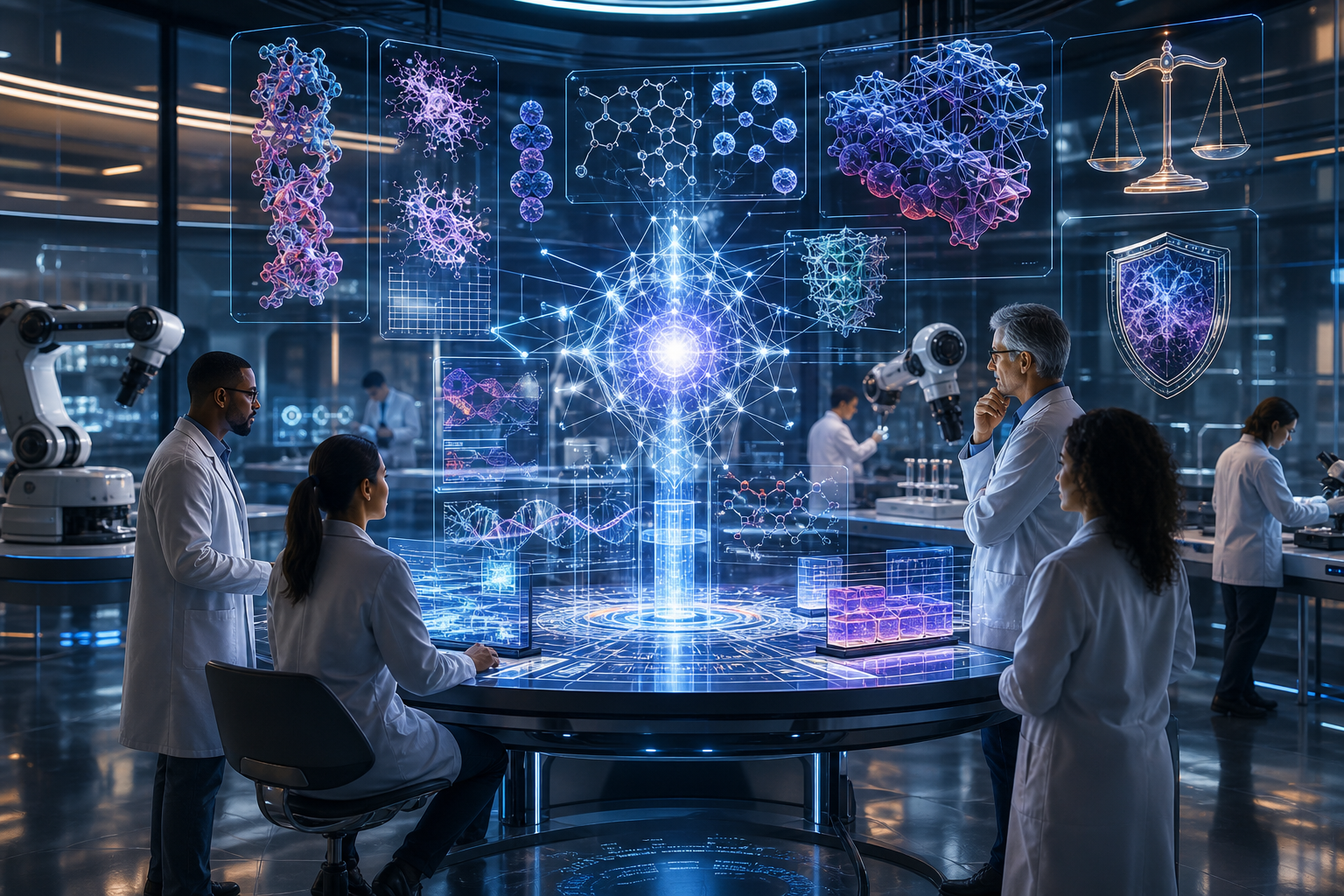
Next-Generation AI Models Usher in Era of Autonomous Scientific Discovery
Recent breakthroughs in artificial intelligence and machine learning are rapidly transforming the technological landscape, moving beyond conversational assistants to drive monumental advancements in empirical science. Over the past year, research laboratories worldwide have unveiled sophisticated multi-modal models capable of reasoning through complex biochemical interactions, predicting protein structures with unprecedented fidelity, and synthesizing vast arrays of genomic data in mere seconds.
These next-generation systems leverage advanced neural architectures that significantly reduce energy consumption while exponentially scaling processing capabilities.

Industry leaders emphasize that the integration of reinforcement learning with unsupervised data synthesis has allowed algorithms to independently formulate and test hypotheses. In the healthcare sector, clinicians are already utilizing these autonomous diagnostic tools to identify early markers of degenerative diseases years before conventional symptoms manifest.
Meanwhile, materials science has experienced a renaissance, as machine learning frameworks accelerate the discovery of novel superconductors and sustainable battery compounds, drastically cutting down the traditional timeline from laboratory bench to commercial deployment.

Despite these remarkable achievements, the rapid acceleration of artificial intelligence has intensified global discourse regarding regulatory frameworks and ethical oversight. Policymakers, technologists, and ethicists are currently collaborating to establish rigorous standards that safeguard data privacy, mitigate algorithmic bias, and ensure transparent decision-making processes.
As these powerful tools become deeply embedded within critical infrastructure, maintaining a balance between innovation and rigorous governance remains paramount.

Ultimately, these breakthroughs signify a fundamental shift in human capability, positioning artificial intelligence not merely as a computational utility, but as an indispensable partner in solving humanity’s most intricate and pressing challenges.