
Afghanistan’s Almond Harvest Is Shrinking — and Farmers Are Running Out of Water
Recurring drought and changing weather patterns are reducing almond production in Afghanistan’s Daikundi province, threatening farmers’ incomes and agricultural livelihoods. Farmers are calling for improved irrigation, modern farming methods, and greater technical and financial support as climate and water pressures intensify.
⚡ THE MOMENT
In the mountains of central Afghanistan, the warning is not coming from a battlefield.

It is coming from the fields.
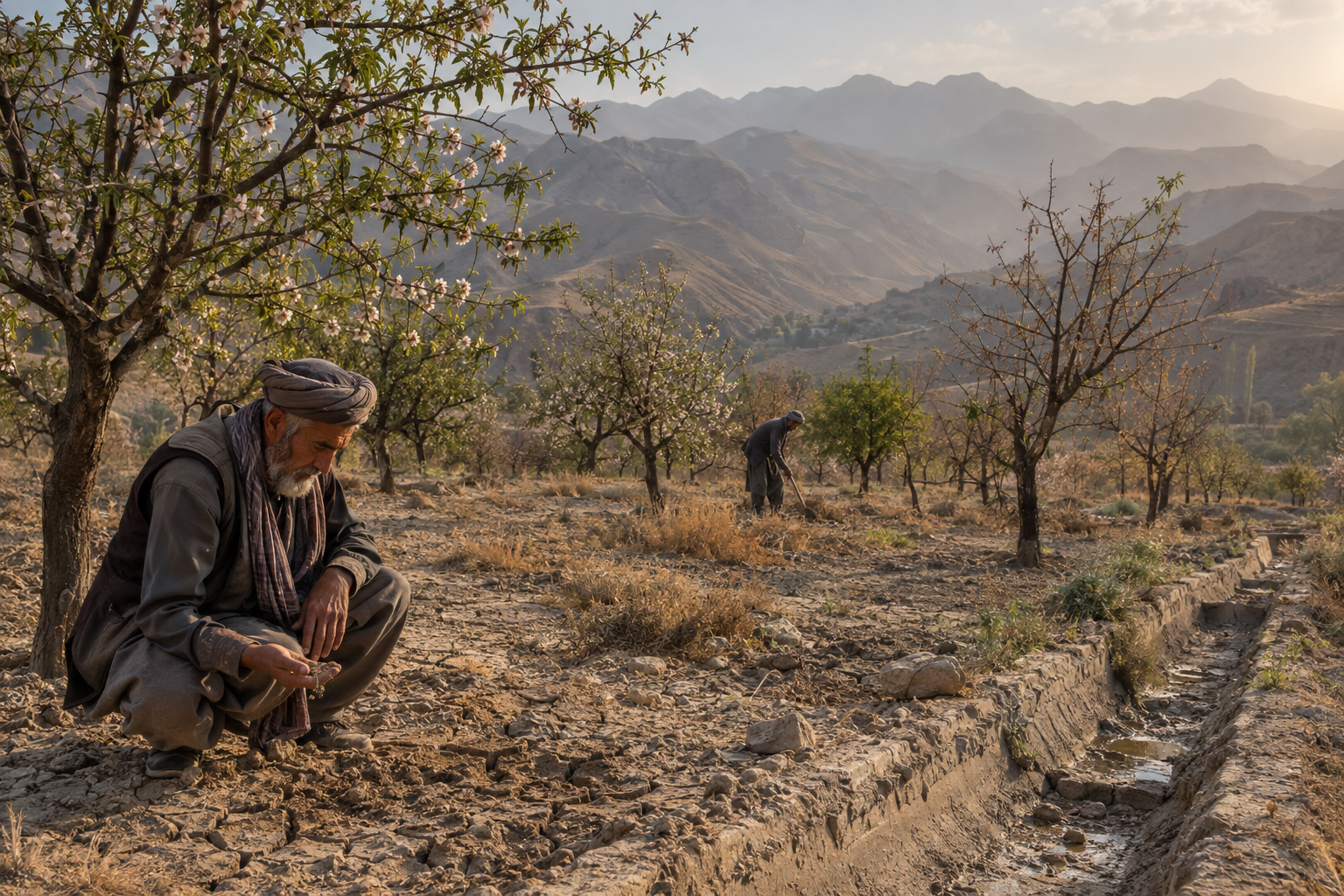
Almond farmers in Daikundi say recurring drought and changing weather patterns have significantly reduced almond production, putting pressure on one of the province’s important agricultural livelihoods.

The problem is bigger than a single harvest.When water disappears from farmland, income disappears with it.
🔎 WHAT WE KNOW

Farmers in Daikundi have reported declining almond production as drought conditions continue to affect agricultural activity.
Local farmers are calling for better irrigation systems and modern agricultural methods to help protect orchards and sustain production.
The development comes as Afghanistan continues to face wider climate and water pressures.
The United Nations has repeatedly warned that climate shocks are increasing the vulnerability of communities across Afghanistan, where agriculture remains closely tied to rainfall and water availability.
⚠️ WHAT REMAINS UNCLEAR
How much agricultural production will be lost if drought conditions continue?
How quickly can irrigation infrastructure be expanded?
And can farmers receive enough technical and financial support to adapt before declining harvests become a long-term economic problem?
Those questions remain open.
🌍 THE BIGGER PICTURE
Afghanistan’s agricultural story is often told through numbers:
harvests, exports and prices.But behind every number is a family.
For farmers in provinces such as Daikundi, climate change is not an abstract global debate.
It can determine whether an orchard produces enough income to support a household.
The challenge is therefore not simply producing more food.
It is keeping Afghanistan’s farmers productive in a climate where water is becoming increasingly difficult to predict.
👀 WHAT HAPPENS NEXT?
The coming agricultural seasons will show whether current adaptation efforts are enough.
For Daikundi’s almond farmers, the demand is straightforward:
better irrigation, modern farming support and a way to keep their orchards productive despite increasingly difficult conditions.
🎯 THE LAST WORD
Afghanistan’s next agricultural crisis may not begin when a field becomes empty.
It may begin much earlier—when the water underneath it starts disappearing.
Ariana Global News